Designing Functional Meal Planner Journal KDP Interiors for Low-Content Publishing
Creating a successful low-content book on Amazon requires more than just uploading a generic template; it demands a deep understanding of user utility and technical precision. When developing Meal Planner Journal KDP Interiors, the balance between aesthetic appeal and practical functionality determines whether a customer leaves a five-star review or returns the product. For publishers focusing on the standard 6x9 inch trim size with 100 pages, the interior layout must be meticulously crafted to accommodate handwriting, prevent bleed-through issues, and provide genuine value to health-conscious consumers.
The specific configuration of a 6x9 journal is deceptively compact. While this trim size is portable and cost-effective for printing, it leaves little room for error in margin settings and content placement. A tested, ready-to-use interior for this format typically adheres to strict safety zones. With margins set at 1.25 inches on the inside (gutter) and 2.5 inches relevant to the overall safe area calculations, designers ensure that no text or writing lines disappear into the binding. This generous gutter is non-negotiable for meal planners, as users often write extensively near the spine when documenting recipes or grocery lists. Neglecting this spacing results in a frustrating user experience where the functional area of the page is compromised by the physical constraints of perfect binding.
Technical Specifications for Print-Ready PDF Files
Before diving into layout aesthetics, the technical foundation of your Meal Planner KDP interiors journal must be solid. Amazon KDP requires print-ready PDFs that meet exact specifications to avoid rejection during the upload process. For a 100-page black and white interior, the file must be exported at 300 DPI (dots per inch). While digital screens display images clearly at 72 or 96 DPI, print resolution demands higher density to ensure crisp lines and legible text. Blurry guidelines or pixelated fonts are immediate indicators of low quality and will deter potential buyers who expect a professional notebook.
Bleed settings present another critical consideration. Even if your meal planner design does not have graphics extending to the edge of the page, selecting the correct bleed option during setup affects the final trim size. For interiors designated as "no bleed," all content must remain within the safe zone. However, many successful meal planners utilize full-page backgrounds or decorative borders that require bleed settings. If you choose to include bleed, your PDF canvas size must increase beyond 6x9 inches to accommodate the extra trim area. Conversely, for a standard interior-only file without edge-to-edge printing, maintaining strict adherence to the 6x9 dimensions with appropriate safety margins ensures consistency across every page of the 100-page count.
Structuring the 100-Page Layout for Maximum Utility
A 100-page count offers a specific cadence for meal planning content. Unlike thicker journals that might span a full year, a 100-page book typically serves as a quarterly tracker, a 12-week wellness challenge log, or a reusable undated planner. The structure should reflect this intended lifespan. Rather than filling pages with repetitive daily grids, high-performing Meal Planner Journal Kdp Interiors often employ a hybrid approach. This might include:
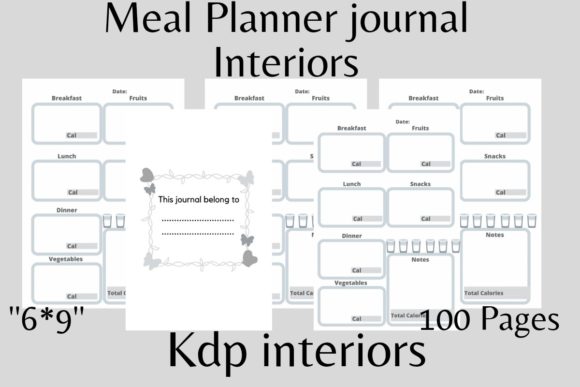
- Weekly Spreads: Two-page layouts dedicated to Monday through Sunday meal slots, including space for snacks and water intake.
- Monthly Overviews: Calendar-style grids for long-term event planning and bulk prep scheduling.
- Recipe Cards: Dedicated sections for recording favorite meals, ingredients, and cooking instructions.
- Grocery Lists: Tear-out or perforated-style sections (simulated via layout) organized by store aisle.
- Reflection Pages: Weekly or monthly check-ins to track dietary adherence, budget spending, and health goals.
This variety prevents user fatigue and increases the perceived value of the journal. When designing for black and white printing, contrast becomes your primary tool for hierarchy. Dark gray headers paired with light gray writing lines create visual distinction without requiring color ink, which keeps production costs low and retail prices competitive. Testing various line weights is essential; lines that are too thick look clunky in print, while lines that are too faint may not reproduce well on standard cream or white paper stock.
User Experience and Handwriting Ergonomics
The end-user of a meal planner journal is typically writing by hand, often in kitchen environments where counter space is limited and multitasking is common. Design decisions must prioritize ergonomics. Line spacing is perhaps the most frequent point of failure in amateur KDP interiors. Standard college-ruled spacing (9/32 inch) is often too narrow for adults writing quickly about ingredients or meal ideas. Opting for wider spacing, such as 3/8 inch or even 1/2 inch, accommodates varied handwriting sizes and makes the journal feel less cramped within the 6x9 footprint.
Furthermore, the placement of prompts guides the user’s interaction with the Meal Planner KDP interiors journal. Instead of blank boxes, effective interiors use micro-prompts like "Protein," "Veggie," "Carb," or "Prep Time" to reduce cognitive load. These subtle cues transform a simple notebook into a structured wellness tool. When testing your interior, print a sample copy and actually use it for a week. Write in it with different pen types. Check if the gutter margin truly allows for comfortable writing near the binding. Verify that the 1.25-inch inside margin provides enough clearance so that users don't have to break the spine to see what they’ve written. This practical validation step separates bestsellers from forgotten listings.
Optimizing for Both Printable and KDP Formats
Many creators now adopt a dual-purpose strategy, designing interiors that function equally well as physical KDP books and digital printables. This maximizes the return on design effort but introduces additional formatting challenges. A file optimized strictly for KDP includes gutter margins that account for binding. However, a home-printed version usually requires symmetrical margins because the user will likely bind it with a spiral coil, disc binder, or simply use it as loose sheets. To serve both markets effectively, some designers create two separate PDF files from the same master design: one with the asymmetric 1.25/2.5 margin setup for KDP, and another with centered margins for Etsy or personal website sales.
When marketing these Meal Planner Journal Kdp Interiors, clarity regarding the format is paramount. Customers need to know immediately that this is an interior-only product and that they must create their own cover. This transparency reduces customer service inquiries and negative reviews from confused buyers. Highlighting the technical specs—6x9, 100 pages, 300 DPI, black and white—in the product description builds trust. It signals that the file is professional-grade and ready for immediate upload or printing. For those selling the editable source files or templates, emphasizing the "tested" nature of the layout assures buyers that the margins have been verified against current KDP guidelines, saving them hours of trial and error.
Niche Differentiation in a Saturated Market
The meal planning category is competitive, making specificity a key driver of visibility. Generic "meal planners" struggle to rank, whereas targeted interiors capture dedicated audiences. Consider adapting the base 6x9, 100-page template for specific dietary frameworks. A Keto-specific interior might include macro-tracking columns and net carb calculators. A plant-based version could feature seasonal produce guides and vegan substitution charts. Budget-focused planners might integrate price-per-serving calculations and pantry inventory trackers. By customizing the internal structure while maintaining the standardized technical specifications, you create a unique selling proposition that resonates with search intent.
Visual consistency also plays a role in niche authority. Even in black and white, thematic elements can reinforce the journal's purpose. Minimalist geometric patterns suit productivity-focused planners, while organic botanical illustrations align with holistic wellness niches. These design choices should be subtle enough not to interfere with writing space but distinct enough to create brand recognition. Remember that in a 6x9 format, every millimeter counts. Decorative elements should frame the content rather than consume it. Testing different header styles and footer placements helps determine the optimal balance between style and substance.
Ultimately, the success of a Meal Planner KDP interiors journal hinges on respecting the physical limitations of the medium while maximizing its potential for organization and health tracking. By adhering to precise margin requirements, ensuring high-resolution output, and prioritizing the tactile experience of handwriting, creators can develop products that stand the test of daily use. Whether intended for direct KDP publishing or as a versatile printable resource, a well-executed interior serves as the silent engine of a successful low-content book business, turning simple paper into a valuable lifestyle tool.