Designing with Dotted KDP Interiors Watercolor Flowers: A Practical Guide for 6x9 Journals
The low-content publishing market has matured significantly, moving past generic lined paper into highly specific aesthetic niches. Among the most enduring and commercially viable styles are botanical themes, specifically those utilizing Dotted KDP Interiors Watercolor Flowers. This design choice bridges the gap between functional organization and artistic expression, appealing to users who want their planning tools to feel personal and inspiring rather than sterile. When creating or selecting a printable notebook or KDP interior featuring this style, understanding the technical interplay between watercolor aesthetics and dotted functionality is essential for producing a high-quality product that actually sells.
Balancing Aesthetic Appeal with Writing Functionality
The primary challenge in designing floral interiors is ensuring the decoration does not interfere with usability. Watercolor art is inherently organic, often featuring soft edges, varying opacity, and flowing shapes. Dotted grids, conversely, are mathematical and precise. A successful 6x9 journal must harmonize these opposing forces. If the watercolor flowers are too dark or saturated, the dots become invisible, rendering the grid useless for bullet journaling or sketching. Conversely, if the flowers are too faint, they look like printing errors rather than intentional design elements.
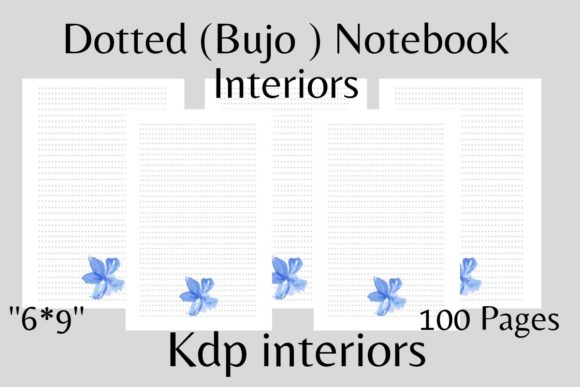
For black and white interiors, which remain the industry standard due to lower printing costs and higher royalty margins, contrast management is critical. The watercolor effect must be translated into grayscale values that retain depth without creating muddy backgrounds. Effective designs typically place the floral elements in the corners or along the outer margins, leaving the central writing area relatively clear. This "framing" technique allows the Dotted KDP Interiors Watercolor Flowers to serve as a decorative border while preserving the prime real estate for handwriting, habit tracking, or mind mapping. The dots themselves should be a consistent medium gray—dark enough to guide the pen but light enough to recede visually when text is added.
Technical Specifications for Seamless KDP Upload
Creating a tested, ready-to-use PDF requires strict adherence to Amazon’s manufacturing specifications. For a standard 6x9 inch journal with 100 pages, the file setup determines whether the book passes review or gets rejected. One of the most common points of failure involves bleed settings. Even if your design appears to have a safe margin, selecting "Bleed" during the upload process requires the PDF canvas to be slightly larger than the trim size. Typically, this means adding 0.125 inches to the top, bottom, and outside edge. A 6x9 document with bleed should therefore measure 6.125 x 9.25 inches.
Resolution is non-negotiable. While digital screens display images clearly at 72 DPI, print requires a minimum of 300 DPI to avoid pixelation. Watercolor textures are particularly unforgiving at low resolutions; artifacts and jagged edges become immediately apparent on physical paper. When sourcing or creating assets for Dotted KDP Interiors Watercolor Flowers, always verify the source file dimensions. Upscaling a small image to fit a 6x9 page will result in blur. Additionally, because this is an interior-only file, creators must remember that KDP does not provide cover templates within the interior PDF. You must generate a separate cover file based on the final calculated spine width of your 100-page block.
Understanding Margin Safety and Gutter Space
User experience in a physical notebook is dictated by margins. Nothing frustrates a journaler more than having to write over a flower petal or losing notes into the binding crease. For a 100-page 6x9 book, the gutter (inside margin) needs to be generous. Industry best practices suggest an inside margin of at least 0.75 inches to 0.875 inches for this page count. This ensures that when the book lies flat, the dotted grid remains fully accessible and the floral decorations do not get swallowed by the binding glue.
The outside, top, and bottom margins also require careful consideration. A minimum of 0.25 inches is required for safety, but aesthetically pleasing journals often use 0.5 inches or more. This white space acts as a visual buffer, making the page feel less cluttered. When positioning watercolor elements, ensure they respect this safety zone. If you are using a full-bleed background texture, it must extend beyond the trim line. However, if the flowers are distinct illustrations meant to be visible, they must stay within the safe zone to prevent accidental cropping during the trimming process. Testing your margins by printing a single page at actual size before uploading can save weeks of wasted time and rejected proofs.
Versatility Across Niches and User Demographics
The specific combination of dotted lines and watercolor florals creates a versatile product that fits multiple use cases. Unlike rigid planners, dotted journals allow for freeform content. This makes them ideal for several distinct audiences:
- Bullet Journalists: Users who practice BuJo need dots for rapid logging but appreciate thematic consistency. Floral interiors provide a seasonal or evergreen theme that enhances the mindfulness aspect of journaling.
- Gardeners and Plant Enthusiasts: The thematic alignment is obvious here. These interiors serve perfectly as garden logs, plant care trackers, or botanical sketchbooks where the printed flowers complement hand-drawn specimens.
- Students and Creatives: For note-taking that blends diagrams with text, the dot grid offers structure without confinement. The soft watercolor aesthetic reduces the clinical feel of academic study, promoting a more relaxed creative flow.
- Mental Health and Wellness: Journaling for anxiety or gratitude often benefits from soothing visuals. Watercolor flowers evoke nature and calm, making the act of writing feel more therapeutic.
By marketing the interior with these specific applications in mind, sellers can move beyond generic keywords and target long-tail search intent. The value proposition isn't just "a notebook"; it is a specialized tool for creative organization wrapped in a calming aesthetic.
Evaluating Quality in Printable and KDP Assets
Whether you are designing from scratch or purchasing a PLR/commercial license asset pack, quality assessment is vital. Not all Dotted KDP Interiors Watercolor Flowers are created equal. When evaluating a potential interior, look for seamless tiling if the pattern repeats. Visible seam lines break the immersion and signal low-quality production to the buyer. Check the dot spacing as well; standard bullet journal spacing is 5mm. Deviating from this without explanation can alienate experienced users who rely on specific measurements for their layouts.
Furthermore, consider the ink coverage. Heavy black ink saturation on standard KDP white paper can lead to bleed-through or ghosting, especially if the user employs markers or fountain pens. Designs that utilize lighter grays and negative space are not only safer for printing but also more practical for end-users. A truly tested interior accounts for the limitations of print-on-demand technology. It avoids placing critical details right at the edge of the trim and ensures that the grayscale conversion preserves the delicate gradients that make watercolor art attractive in the first place.
Optimizing the Interior for Print-On-Demand Success
Success in KDP relies on reducing friction between the customer's expectation and the delivered product. Since customers cannot physically flip through the pages before buying, your listing images and description must accurately represent the interior's tone. If your watercolor flowers are vintage and muted, do not describe them as vibrant and modern. Misalignment between the cover promise and the interior reality leads to negative reviews.
Additionally, consider adding value-added pages to your 100-page block. While the core is the dotted floral grid, including a few pages of solid watercolor dividers, index pages, or yearly calendars can differentiate your book from competitors using identical stock assets. These functional additions increase the perceived value of the journal. Remember that every page counts toward the spine width, so any additions must be factored into your cover calculations. Ultimately, the goal is to create a cohesive physical object where the Dotted KDP Interiors Watercolor Flowers enhance the utility of the notebook rather than merely decorating it. By focusing on technical precision, user-centric margins, and thematic versatility, creators can produce journals that stand out in a crowded marketplace and genuinely serve the needs of the journaling community.