Optimizing Your KDP Interiors Project Log Book Planner for Professional Results
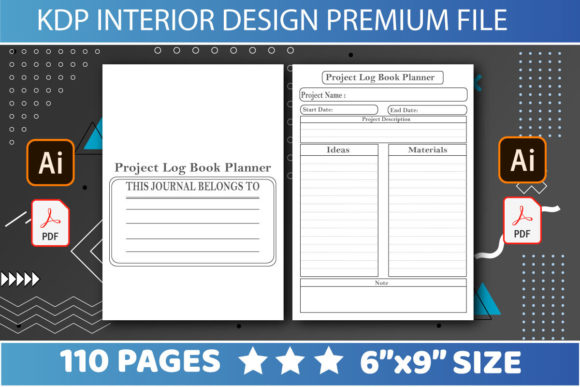
Creating a successful low-content book on Amazon requires more than just uploading a generic template; it demands precision, usability, and adherence to strict printing guidelines. When designing or selecting a KDP interiors project log book planner, the specific technical parameters define whether the final product feels like a professional tool or an amateur attempt. The 6″ x 9″ trim size has emerged as the industry gold standard for portable logging, offering the perfect balance between writing space and carry-ability. Understanding how to leverage this specific dimension alongside a 110-page count and no-bleed settings is essential for creators who want to deliver high-value resources to contractors, freelancers, and hobbyists.
The Strategic Advantage of the 6x9 Trim Size
The decision to utilize a 6″ x 9″ format for a project log is rarely accidental. This dimension mimics the footprint of a standard trade paperback novel, making it familiar to handle yet distinct enough to serve a functional purpose. For end-users, this size fits comfortably in cargo pockets, tool belts, glove compartments, and small purse organizers. Unlike larger 8.5″ x 11″ formats that require a clipboard or desk surface, the 6x9 log book encourages on-the-go documentation.
From a design perspective, this compact canvas forces intentionality. Every millimeter of margin and column width must be justified. When working with a KDP interiors project log book planner at this scale, designers cannot rely on excessive white space to fill pages. Instead, the layout must maximize utility through efficient typography and smart grid systems. The 6x9 constraint actually improves the user experience by reducing visual clutter and focusing attention on the data entry fields that matter most, such as timestamps, task descriptions, and material costs.
Maximizing Utility Within 110 Pages
A page count of 110 pages represents a strategic sweet spot for spine width and perceived value. Books under 100 pages often lack a printable spine text area on KDP, which can make them look less professional on a shelf or in search results. At 110 pages, the book achieves sufficient thickness to display a title clearly while remaining lightweight enough for daily field use.
This specific length also influences how the interior content should be structured. Rather than repeating a single daily log page 110 times, effective planners often utilize the first few pages for project overviews, contact directories, or safety checklists. The remaining pages can then be dedicated to the core logging function. This variety increases the book's utility without increasing production costs. Users appreciate a resource that serves multiple organizational needs within a single, cohesive volume rather than requiring them to carry separate notebooks for different types of information.
Navigating No Bleed Specifications Safely
One of the most critical technical aspects of producing a KDP interiors project log book planner is understanding the "no bleed" setting. In printing terminology, bleed refers to artwork or background colors that extend beyond the edge of the trim line. Selecting "no bleed" means all content must remain safely within the margins, surrounded by a border of unprinted paper.
While some designers view no bleed as a limitation, it is actually a safeguard for functional books. Ink that extends to the very edge of a page can smudge during handling or get trimmed unevenly during manufacturing. For a log book intended for job sites or workshops, clean edges are preferable. However, this requires disciplined file setup:
- Maintain Safe Zones: Keep all text and critical lines at least 0.375 inches from the top, bottom, and outside edges.
- Account for Gutter: The inside margin (gutter) must be wider to accommodate binding. For a 110-page 6x9 book, a gutter of at least 0.375 to 0.5 inches ensures users don’t have to break the spine to write near the center.
- Visual Balance: Without full-page backgrounds, use subtle borders or corner accents that stay within safe zones to add visual interest without risking print errors.
Adhering to these constraints prevents the frustrating rejection emails from KDP’s automated review system and ensures the customer receives a crisp, usable product every time.
Leveraging Editable AI and PDF Source Files
The true longevity of a low-content publishing business lies in asset reusability. Acquiring or creating a KDP interiors project log book planner in both PDF and AI (Adobe Illustrator) formats provides unmatched flexibility. While the PDF is the final deliverable for KDP upload, the AI source file acts as the master template for future iterations.
Editable vector files allow creators to adapt a single core design for multiple niches without starting from scratch. A general construction log can be modified into a specialized electrical inspection tracker, a gardening journal, or a freelance client intake form simply by updating headers and adjusting column labels. Because AI files retain layers and editable text objects, these changes take minutes rather than hours. This workflow efficiency is vital for scaling a catalog and testing different market segments.
Furthermore, having access to the original source files protects against platform obsolescence. If KDP updates its margin requirements or trim size tolerances, an editable AI file can be adjusted to meet new standards instantly. Relying solely on flattened PDFs locks you into a static product that may eventually fail quality checks or become outdated.
Designing for Real-World Application
Technical specifications matter only if the final product solves a genuine problem. When evaluating or designing the interior pages, consider the physical environment where the book will be used. A project log for outdoor landscaping faces different challenges than one for indoor software development tracking.
For physical trades, line weights should be substantial enough to remain visible in low-light conditions or when printed on standard cream paper. Fonts should be sans-serif and highly legible at smaller point sizes to conserve space within the 6x9 boundary. Input fields need adequate height to accommodate handwriting, which varies significantly in size compared to typed text. Testing the layout by printing a sample page at actual size and writing in it with a standard ballpoint pen is an invaluable step that digital-only designers often skip.
Digital nomads and remote workers using these logs for productivity tracking may prefer cleaner aesthetics with lighter gray lines to reduce visual noise. They might benefit from integrated habit trackers or goal-setting sections that complement the primary logging function. The versatility of an editable KDP interiors project log book planner allows you to create distinct versions tailored to these specific user personas while maintaining consistent quality and formatting standards.
Quality Control Before Publication
Even with perfect source files, pre-publication verification is non-negotiable. Always download the digital proof from KDP before approving publication. Zoom in to 100% to check that no elements violate the no-bleed safety margins. Verify that the gutter space remains consistent throughout the 110 pages, especially if your design includes any centered elements or double-page spreads.
Consider ordering a physical proof copy as well. Screen resolution can be deceiving, and what looks spacious on a monitor may feel cramped on paper. Holding the 6x9 book in your hands reveals ergonomic truths about binding tightness, paper opacity, and overall usability that digital previews simply cannot convey. This extra step separates professional publishers from hobbyists and directly impacts customer reviews and long-term sales performance.
Ultimately, success in the low-content space comes from treating these products as legitimate tools rather than disposable content. By respecting the technical boundaries of the 6x9 no-bleed format, utilizing the 110-page count strategically, and maintaining editable source files for ongoing optimization, you build a sustainable asset library. Each KDP interiors project log book planner becomes not just a file upload, but a refined solution that earns its place in a user’s daily workflow.